Showing posts with label guest post thursday. Show all posts

Thursday, March 10, 2011

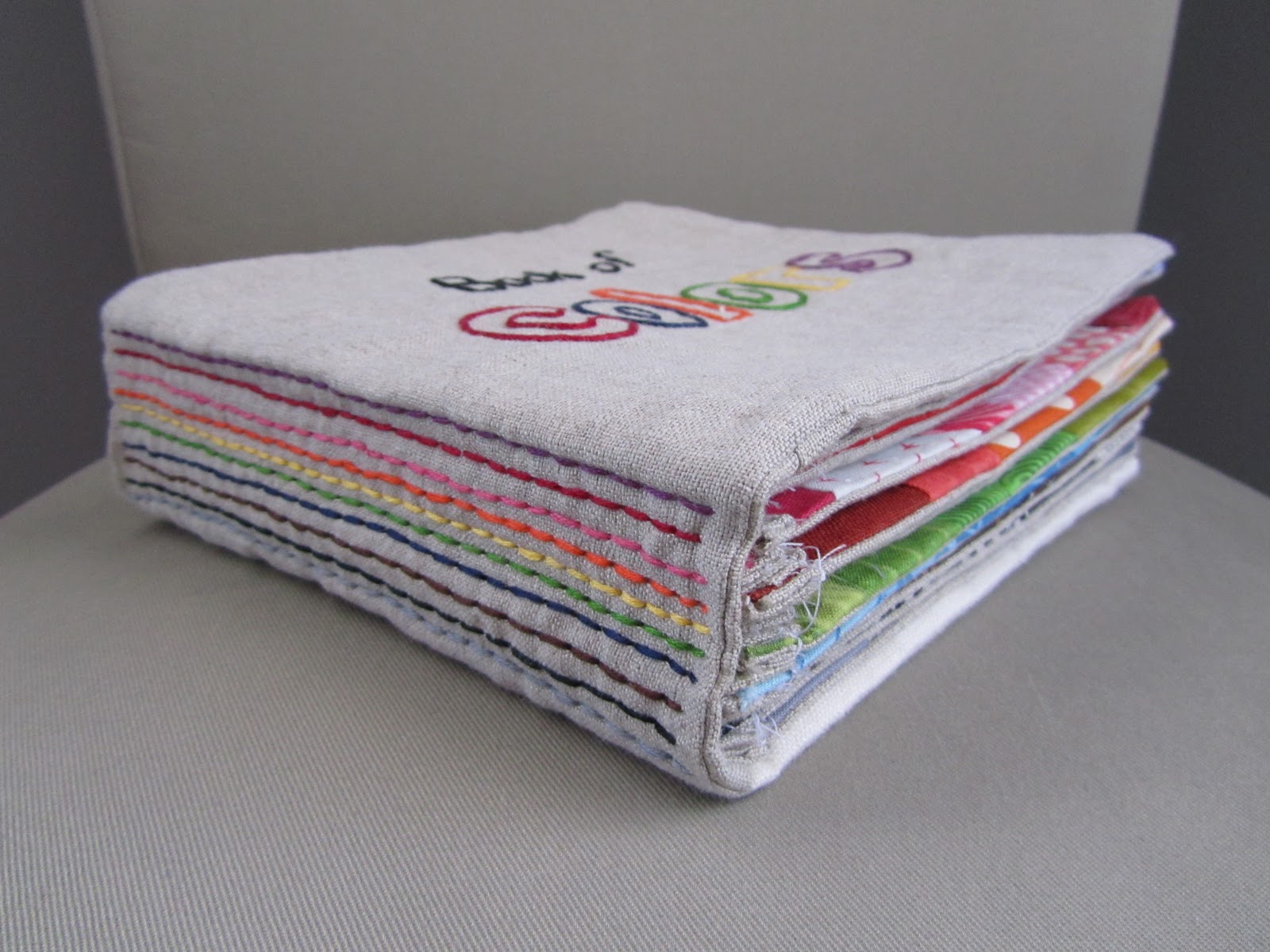
*Guest Post Thursday* - DIY "Colors Book" for baby

I have a treat for you today friends.  The very talented Jessica from Insanely Crafty is  here today show us how to make this "Colors Book".  She made it for her little boy, and it is just darling.  Her attention to detail in this tutorial makes it very easy to follow and understand.  Visit her blog for more inspiration and cute pics of her little one.  Take it away Jessica!

First of all,  I want to thank Jessica for asking me to share a tutorial on her blog!

I had my first child last year and he may be slightly spoiled with hand made items. On the long list of things I wanted to make for him was a book to learn his colors. That's what I am here to share with you! I hope you enjoy making it as much as I did.  I would love to see your completed project so please share by joining my flicker group!

 
Supplies
1/2 yard linen fabric
1 yard one-sided fusible interfacing
Scrap fabric (purple, red, pink, orange, yellow, green, blue, brown, black, gray, white)
Embroidery floss  (purple, red, pink, orange, yellow, green, blue, brown, black, gray, white)
Fabric Paint (purple, red, pink, orange, yellow, green, blue, brown, black, gray, white)
Freezer paper
X-Acto knife
fabric marker
small embroidery hoop
Printed word template
optional: plastic bag
Cutting directions-
Linen
(11)      8” x 8” – Pages
(1)        17” x 8” – cover
(1)        8” x 3.5” - spine
(10)      8” x 3” – binding
Interfacing
(10)      7.5”x7” - pages
(1)        16” x 7” – cover

Assembly Directions
Note: All seam allowances are 1/2’’.
1. Create and 8”x8” block for each of the 11 colors from your scrap pieces. Try to add at least one textural fabric to each page, I used minky, felt, fleece, and flannel to achieve this. In some cases I appliquéd additional fabric to the top of my block for added interest.

2. Trace each of the colors onto freezer paper using your word template. Following your traced lines,  cut out each letter with an X-Acto knife.
*helpful hint - Any letters that have little pieces like an 'e' that will need to be used leave them just slightly attached until your ready to iron so you don't have to worry about loosing the pieces

3. Iron a piece of freezer paper to the back of the page and then center the cut out word on the front of the page and iron it on. Make sure the iron is on a high heat setting so the wax makes a good seal to your page. Repeat for all pages.

4. Paint each word with it's corresponding color. Then let dry and heat set per paint bottle instructions.
*tip always heat set from the back of the fabric it keeps paint from transfering to the hot iron and ruining your project.


5.  From your word print out, cut out the book title to make a stencil, don't worry about keeping the inner detail.

6. Center your stencil on the right side of your Cover fabric as in the example below

7. Use the stencil to draw out your embroidery lines

8. Use a running stitch over the top of the outline.

9. Layout the book in order purple, red, pink, orange, yellow, green, blue, brown, black, gray, 
white.  

10.  With exception of the purple word page and the white scrap page. Put pages right side together in order (example purple scrap page goes with red word page, red scrap page goes with pink word page, etc.) You will only be sewing three sides. The side to the left of word must be sewn. Lay the pairs out and pin the one side that should be sew. 
Sew around the top, side and bottom of the page (1/2" seam allowance). I like to double check my measurements before sewing along the bottom- you want your pages to be 7 inches top to bottom and 7.5 inches from sewn to unsewn side edge. 


 Once three sides are sewn clean up you edges and snip the corners

11. Iron on the interfacing to the inside to your page. 
**Optional add plastic bag in some of your pages to make a crinkle page. (thank you Jennifer for this idea!)

12. Flip page right side out and iron

13. Bind your page edge.
First fold each binding piece in half and iron, fold down the top and bottom of each binding piece to make a 7"  strip,  pin to the unsewn side of the page and sew with a 3/8" seam allowance. Press seam. Snip page edges and fold in binding corners, pin in place.
Sew down. repeat for all pages 

14. Sew the spine (8"x 3.5")between your purple word page and your white scrap page. 

15. Put right side together with the cover and sew around the outside leaving a 3" opening for turning.

16. Trim the edges, clip corners and iron on interfacing

17. Turn right side out, iron, and hand stitch closed. 

18. Position 1st and last pages on your "book spine" making sure they will be covered when the book is closed. Put a pin where the page will need to be sewn in at the top and bottom. Use a ruler and draw a straight guide line down the cover.
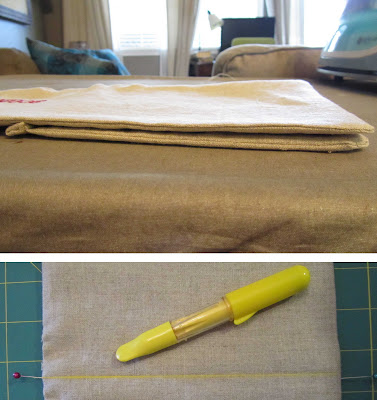
19. Use a running stitch to attach the first and last page to the book. Use the corresponding color to the page you are sewing in.

20. Once the front and last page are sewn in place evenly divide the area between them among the 8 remaining pages. Draw guidelines again to keep your page and stitches straight. 
Sew in remaining pages.


Wow!  How amazing is that?!?  Give Jessica some love and leave her a comment!  The more you comment, the more chances to win the tote!!  Have a great day!
jessica

Friday, January 7, 2011

*Guest Post* - Heart "warming" Story

Happy Friday to all!  Today I have a guest post from Tristin about a group project she and several friends made as a gift - but I'll let her tell you about it...

First of all, thank you Jessica for having me as a guest today!  I've been a guest on Sew Homegrown before when I was writing for my previous blog, but I've now joined forces with my great pal Sharon on a new blog called Two Girls Being Crafty

Today I'm excited to share how 9 women with varying crafting skills came together to create a beautiful keepsake for a beautiful bride-to-be!  If you're a crafty gal with crafty friends, here's a fun group project you may want to try out sometime.

completed crocheted granny square afghan

The granny square afghan was the brain-child of Jessica's Aunt Gabi (with whom Sharon and I attend church).  She thought it would be a fun idea for some of the ladies of our congregation to get together to make a special gift for our preacher and his wife-to-be as a wedding gift.  Pretty smart lady, huh?

So, a group formed and we gathered weekly to learn how to crochet.  There were 9 women who worked on the afghan and of the 9, 6 were rookies who had never even touched a crochet hook.  The women who were proficient in the skill educated the newbies (including my blog-mate Sharon and I) in the art of crochet.  Thinking back to the first gathering, I'm sure we looked pretty comical.  We didn't "get it", we were frustrated, and the yarn wasn't the only thing that needed a tension adjustment (that's crochet humor).

close-up of crocheted granny square

If you're interested in making a classic granny square like we learned how to, the Purl Bee has a wonderful tutorial.  It's very similar to the pattern we used and it has lots of helpful pictures.

The group of us shared laughs, meals, frustrations, and more laughs.  We grew closer together, and I think that's what made the project such a neat and memorable one.

crocheting granny squares for afghan

With all of us sharing the cost and the labor, the project was not such a daunting undertaking.  If you're looking for a fun way to make a memorable gift for someone, I'd suggest doing a similar project.  Or how about a good old-fashioned quilting bee?  Wouldn't it be neat if a group of cousins got together to make an afghan for grandparents?

Lessons learned? 

It's important to all be on the same page.  Had we all gone our separate ways and crocheted with varying tensions and yarns, the project could have been a disaster.  Getting together to make sure our squares were consistent and very close in size was imperative for the fruition of this project (and group emails helped, too!).  It also kept the project fun

Having a group leader like Gabi made a difference too.  Someone has to be the final authority in order to keep a project like this organized and to make it a success. 

crocheted granny square afghan


The project was a hit!  The bride-to-be loved the afghan and I am sure it will be treasured in her family for years to come!

As a group, we've created strong a bond, and have all gone on to really enjoy the therapeutic qualities of crochet.  Pretty awesome, huh?

The final outcome was so exciting for all of us to see.  Let's check it out again:

Granny square afghan--Made with love

Each square is unique and when you put all of those unique squares together a fabulous afghan is created.  Each of the nine women involved brought something unique to the group, and together we were capable of much.  Who knew a simple afghan could be more than just a blanket?

thanks Tristin - isn't that a cool idea?  Hope you're inspired like I was by that story.  
Stay warm and cozy this weekend.
xo,
jessica

Thursday, December 9, 2010

*Guest Post Thursday* Repurposing A Canvas Bag (AKA Making It More Awesome)

Good morning!  Today my good friend Laura is here to share with us a quick and easy redo for a canvas bag.  I actually saw one really similar to her finished product in a catalog the other day!  Also a reader, Pam, inquired about the candy canes on the banner of my  blog - the tutorial to make them is in this online mag - so fun to make!  Good luck Pam!  Now let's all read Laura's tutorial!

 
I've been wanting a big serviceable carry-all canvas bag for a while but I'm a cheapskate. I pilfered this canvas tote from my mom's stash of reusable grocery bags. It looks like it was free from a company. Let's get rid of that logo.
Here's the other side:
Pick your fabric--I went with plaid (2 different kinds for fun) because I'm a plaid-lover right now:
Cut out a piece a little bigger than you need. I don't measure because I'm lazy! Also I'm a very apathetic crafter so if I don't hurry and complete it in one sitting, I might never finish it. I just wanted to cover the pocket on this side but you'll see what I did on the other side in a minute. 
Do the same thing on the other side! Here's where I felt like a creative genius. I used an old flannel shirt and cut it so that the buttons and pocket stayed intact. Then fold each edge under and iron it flat so you have some nice edges:
Pin that nicely ironed fabric to the bag:
Slide the bag around the arm of the sewing machine (get your mom to thread it because you can never remember how) and sew a straight line on each side (pivot at corners...hopefully you know what pivot means).
There. That looks nice:
Flip it over and do the same on the other side. Just be careful and know how much fabric your machine can stand at once (mine groaned a little because of the thick canvas but it was fine).
Stash your sketchbooks, records, and converse shoes inside and you are ready to go meet your hipster friends for lunch!
  
Thanks Laura!  This could also be a nice gift -inexpensive to make too!  Hope everyone is having a lovely week!
jessica

Friday, November 19, 2010

*Guest Post* - Hand-embroidery lesson

We are so lucky to have my friend Melissa here today.  She does some gorgeous hand-embroidery, something at which I am a novice.  That's why I'm so excited to have her here to give us a basic embroidery lesson!  Use these skills to make a project for the giveaway!  Remember, you are automatically entered just by uploading any project (recipe or sewing) to the Flickr Pool.  The drawing for the winner will be random - so don't worry about making a perfect project.  Good luck and take it away Melissa!


Hi there!  Hope everyone is having a fabulous fall!  This tutorial is to introduce you to hand embroidery.  The great thing about hand embroidery is that you can make a simple project very personalized in just a matter of minutes.  If you are the type of person who likes to have patterns for things, there are a number of different places to find them:  your local fabric store and websites.  Here are some great sites to get patterns from (some are free and some you have to purchase):

Here are the items that you will need for this project: 
2 skeins of embroidery floss (I used two different colors; the number you will need will depend on the size of your project), embroidery (or small) scissors, embroidery needles, something to embroider on (hand towel, dress, cardigan, etc.), a pattern (purchased, free, or hand made), a washable fabric marker, an embroidery hoop (wooden or plastic), a measuring tape
Some optional items include:
Thimble (leather or another kind of flexible thimble), needle threader, needle puller, fusible interfacing, tape, straight pins
The stitches I will be using in this tutorial include:
the back stitch (http://www.needlenthread.com/2006/10/embroidery-stitch-video-tutorial_24.html) and the chain stitch (http://www.needlenthread.com/2006/10/embroidery-stitch-video-tutorial-chain.html).
Both of the stitches are staples in hand embroidery.  Feel free to watch the videos for some live action on how to perform the stitches.  Neither of the stitches is really difficult, but each creates a unique effect.  What I really love about embroidery is that you can make anything look unique, by applying different stitches.  Each stitch creates it’s own texture.  The chain stitch is founded in the “Lazy Daisy” stitch (http://www.needlenthread.com/2006/11/daisy-stitch-video-tutorial.html).  
When I was growing up, my grandmother referred to this stitch as the “Petal” stitch.  The chain stitch is a great fill stitch, but also looks really cool as outline.
The embroidery floss can be used as one complete unit (all 6 strands), or separated into smaller groups of thread (2, 3, 4, or 5) depending on the stitch you are doing and the effect you want.  For the backstitch, I tend to use all 6 strands, as it makes for a fuller effect.  For the chain stitch, I use 3 strands.  Play around with these, and see which you prefer. 
First, measure the center of your fabric in width, and then measure how far down on the item you want the design to be. 
My project is a reversible toddler dress.  

Next, make some marks where the center of your design should be. Then, put your pattern on the front of your fabric, and ensure that you are happy with the placement.  
 
The next step is optional.  I find that it is particularly useful when I choose to fill-in an embroidery project, instead of just doing an outline.  Should you so choose, fusible interfacing (iron-on) can be placed on the wrong side of the fabric in line with the pattern on the right side of the fabric.  What is important here is to make sure that you use enough interfacing to cover the entire area of where the design will eventually be.  I find that on stretchy fabrics, the interfacing really helps.  Some people do not use it, as it is an extra layer to embroider through.  If you are just starting out, I would recommend using it. 

 
Turn your fabric right-side out again, and trace on your pattern.  I tend to use hand drawn patterns, as I always find myself tweaking the purchased ones to fit my needs.  I used some tape to help stabilize my pattern while tracing.  If it is a fabric with less pattern than shown here, you can trace through the fabric and place the pattern below, without having to trace around a cut-out.  I often use a window to help “light” the fabric and the pattern.  Tape the pattern to the window, then tape the fabric over the pattern, and trace with a washable fabric marker. 
Now that you have traced on your pattern, you are ready to get started with the embroidery.  Place your hoop around the design (or around the area of the design you are working on).  I use a wooden hoop, as I feel that for me it helps to keep the fabric from shifting.  After threading your embroidery needle with the 6 strands of floss, make a knot in the floss.  If you are not sure how to do this, there are some great videos on the sites listed below.  Start with the backstitch, and outline your pattern.  You could do this in a contrasting color to make it really pop. 
 
The key with the backstitch is to make it as even as you can.  Some irregularities give it some charm and a really nice home-made feel. 
Now that your outline is complete, you are ready to fill in the design (also optional).  For the fill on this pattern, I chose the chain stitch.  Split your floss into three strands of thread.
 
Once you are finished filling in the design, you can add some extra touches in contrasting threads, as shown here.  Filling in a design can take a lot of time.  It depends on the look that you are going for.  If it is your first project, you may consider just doing an outline and then filling in on a later project.  


For the extra touches, I used the chain stitch in a contrasting color to make it look more like a maple leaf. 
Be creative and come up with your own ideas/patterns!  One of the best tips my grandmother ever gave me regarding embroidery by hand is to take breaks.  If you work for too long, you can stress the muscles in your hands, wrists, and arms.  I use an embroidery brace now, because it helps to stabilize my hand. 
Embroidery is great, because you can do monograms, collegiate logos/mascots (if you’re an SEC freak like I am), and just about anything you could imagine.  It’s also a relatively inexpensive way to spice up some of your projects with a personal touch.  Feel free to check out my Flickr to see some ideas for some other projects: http://www.flickr.com/photos/thehallhappenings/ or on my blog: The Hall Happenings (currently under construction by my fabulous husband, to be returned to working order shortly!).
Here are some great sites for tips on embroidery if you are interested:

Thanks for having me on Sew Homegrown, Jessica!
~Melissa

Thanks for all of your great tips Melissa!  Now everyone get busy so you can win that ADORABLE Bridget and Lucy Ruffle Joy Kit!  Have a great weekend.
jessica

Thursday, October 14, 2010

*Guest Post Thursday* - Pumpkin Luminary

Welcome back for another Guest Post Thursday!  My talented friend Shannon is here again with a lovely fall tutorial for us - a fragrant pumpkin luminary.  I can't wait to make one!  Also - two things - today Prudent Baby is hosting me as a guest (so honored!!) and if you haven't taken the poll over there on the right, please do so I can make this blog better for you!! I may have a few more polls coming soon so keep looking and posting your answers.  Thanks!   So back to my guest - take it away Shannon!

Here in East Tennessee, the autumn weather is full of beautiful, warm colors that play off the crispness in the air. I love the color orange, so when decorating for fall, I have ALOT of orange throughout the house. I especially love using pumpkins because they are so versatile when decorating for autumn, Halloween, and Thanksgiving. However this year, my mini pumpkins upon my mantle just didn't have the "pop" I wanted. The color and size were just right but I felt I was missing that extra spark.

I wanted a bit of twinkle, and what better way that to add twinkle than to use a tea light. I shall make a pumpkin luminary! So I got one of my little pumpkins and cut the bottom out of it and hollowed it out. I cut the bottom and not the top, so it would be easier to light my tea light and place the pumpkin luminary over it. This way I wouldn't have to light the candle from the top. Since the pumpkin was so small, it took five minutes total. Make sure that you scrape the inside very well, leaving no trace of the stringy goo that holds the seeds to the pumpkin wall.
Next I used my strawberry huller to cut circles into the wall of my pumpkin. You could also use an apple corer and punch through the wall, or if you are really handy with a knife, carve some hearts or spirals. The wall is rather thin so it doesn't take much effort to cut through the pumpkin.
Now that my pumpkin luminary is constructed, I thought it might be nice to add a bit of spice. Cinnamon, ginger and cloves to be precise (I will stop the rhyming now). I used a pinch each of cinnamon, ginger and cloves. I mixed them together and rubbed the spice mixture evenly on the inside of the pumpkin, taking care not to get it too close to the holes (which is why I rubbed, not sprinkled).
 My luminary is finished. My daughter made a trivet our of a 2 inch slice of a tree limb in preschool, which provided for a nice base for my tea light and pumpkin luminary, don't you think? 

I lit my tea light, placed my pumpkin luminary over the candle and dimmed the lights. What do you think?


My husband thought he was having pumpkin pie for dessert when he got home, so the scenting worked nicely, and now I need to go make a pie. You could easily do this with a pie pumpkin and make a table centerpiece. Enjoy your pumpkins this Autumn!

Thanks Shannon!  If you would like to be a guest on Sew Homegrown, just send me an email from the Contact Me section.  Have a great day!
jessica

You may also enjoy...

Related Posts Plugin for WordPress, Blogger...